


What Panhandle Dust Actually Does Inside a Lock Cylinder
A standard pin tumbler lock cylinder has a tight tolerance between the plug and the shell. That tight fit provides security, but it leaves very little room for contaminants. Panhandle dust is fine, alkaline, and persistent. Once it works into a keyway, it mixes with factory lubricant and forms an abrasive paste that wears down the pins, springs, and driver pins controlling the lock’s movement. A key that once turned smoothly starts to require extra force, and the lock begins to feel gritty with every use.
Wide temperature swings accelerate the problem. Amarillo summers push well above 100 degrees, and winter nights can drop below freezing. That expansion and contraction cycles lubricant in and out of working surfaces, pulling in more dust with each cycle. By the time a lock begins to bind noticeably, internal components may already be significantly worn.
How Wind Pressure Strains Door Hardware and Lock Alignment
Sustained Panhandle wind puts direct mechanical stress on doors and their hardware. A door pushed and pulled repeatedly by strong gusts will eventually shift in its frame, changing the alignment between the latch bolt and the strike plate. When alignment is off, the latch does not seat cleanly, and the deadbolt may drag or refuse to fully extend. You can often feel this as a scraping sensation when turning the key.
Wind-driven debris adds another layer of damage. Grit traveling at speed against a lock face strips protective finishes and exposes base metal to moisture and rust. Chrome, nickel, and brass finishes all wear faster in exposed Panhandle locations than in sheltered environments. Once corrosion sets in, it accelerates the internal wear already caused by dust buildup. Our lock installation and repair service addresses both internal wear and hardware alignment issues that Panhandle conditions create.
Signs Your Exterior Lock Has Been Compromised by Wind and Dust
Not every lock problem is caused by the weather, but these specific signs point to dust and wind as contributing factors. Watch for any of the following on your home or business exterior locks.
- A key that requires noticeably more force than it used to
- Gritty or grinding resistance when turning the cylinder
- A latch or deadbolt that does not retract or extend fully
- Visible pitting, discoloration, or corrosion on the lock face
- A door that has shifted so the latch and strike no longer line up cleanly
- A lock that works inconsistently depending on whether you lift or push on the door
Any of these symptoms is worth addressing before the lock fails at an inconvenient moment. A lock already struggling in mild conditions may give out entirely during a windstorm or a cold snap.
What Frog’s Safe & Key Does to Protect and Restore Your Locks
The right response depends on how far the damage has progressed. For locks that are gritty but still functional, a proper cleaning, a dry lubricant suited for dusty environments, and a strike plate adjustment can restore smooth operation. We avoid heavy grease products for Panhandle locks because thick lubricants attract and hold the very dust particles you are trying to keep out. Dry lubricants such as graphite or PTFE-based sprays are a much better match for these conditions.
When a cylinder is worn past the point of restoration, replacement is the more reliable path. We install locks from brands including Schlage, Kwikset, Sargent, and ASSA Abloy, and we can help you choose a grade and finish that holds up better in exposed locations. If you need updated keys after a lock swap, our lock rekeying service is available. We handle work for both homes through our residential locksmith service and businesses through our commercial locksmith service throughout the area.
Protecting Exterior Locks Before Damage Accumulates
Preventing wind and dust damage is easier than reversing it. A few straightforward habits can extend the life of your exterior locks considerably in the Panhandle climate.
- Have exterior locks cleaned and lubricated at least once a year, ideally before the hottest months when dust storms are most frequent
- Check that door strikes are properly aligned after any significant storm, since even slight shifting accelerates latch wear
- Consider grade-1 commercial locks for heavily used exterior doors, as higher-grade hardware resists particulate wear better
- Keep door frames and weatherstripping in good condition to reduce dust reaching the lock cylinder from inside the door
Serving Amarillo and the Texas Panhandle
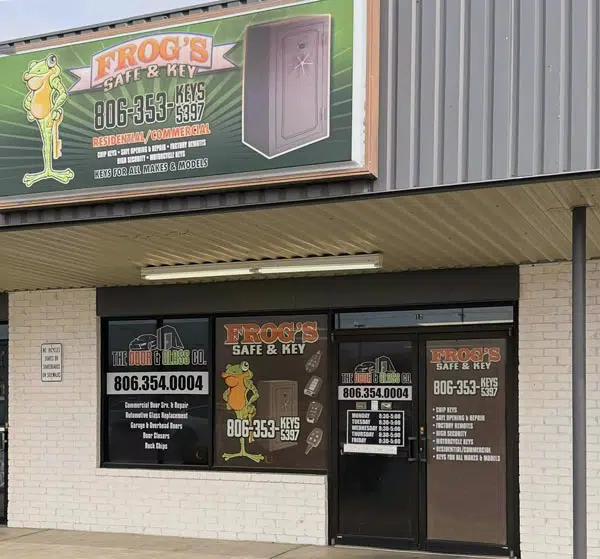
Frog’s Safe & Key serves Amarillo, Canyon, Hereford, Plainview, Borger, Dumas, Pampa, Perryton, and communities within a 60-mile radius. We are licensed by the Texas Department of Public Safety, License number B09391101, and fully insured, with a 90-day warranty on products and labor and flat-rate pricing with no hidden fees. Whether your exterior lock needs a cleaning, an alignment correction, or a full replacement, you can visit our staffed Amarillo storefront or request mobile service. Contact us today for a free service quote and to schedule lock service at your home or business.